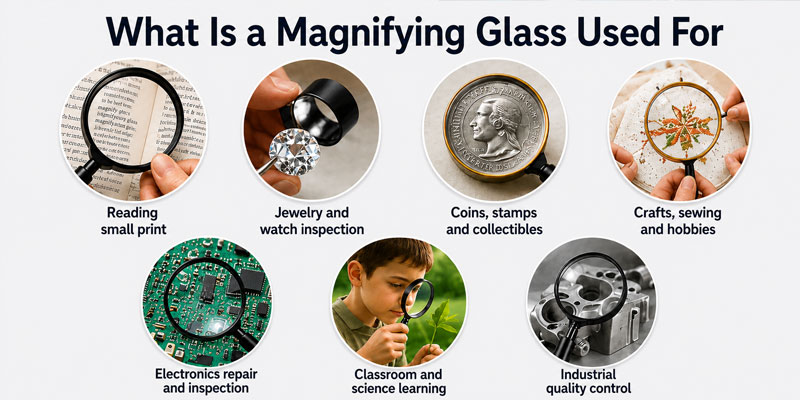
A magnifying glass is used to make small text, small objects and fine details easier to see. People use magnifying glasses for reading small print, inspecting jewelry, examining coins and stamps, repairing electronics, doing crafts, teaching science and checking tiny surface details in industrial work.
The basic idea is simple: when your eyes cannot pick up enough detail on their own, a magnifying glass gives you a closer look without needing a microscope.
What is a magnifying glass?

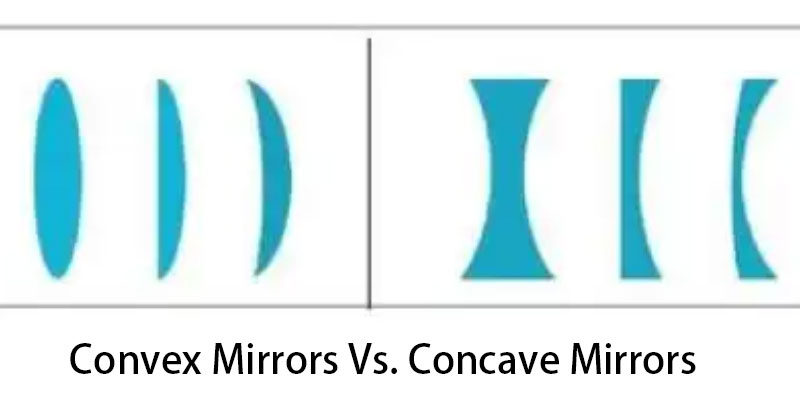
A magnifying glass is a simple optical tool made with one or more convex lenses. The lens may sit in a handle, a folding case, a desk stand, a headband or a lighted frame. It does not make the object itself larger. It changes how light reaches your eye, so the object appears larger.
You will see many versions of the same basic tool: a hand held magnifying glass for reading, a pocket magnifying glass for travel, a lighted magnifying glass for dim spaces, a desk magnifying glass with light for bench work, and a loupe magnifying glass for close inspection. The right choice depends less on the name and more on how you plan to use it.
How does a magnifying glass work?
A magnifying glass works because a convex lens bends light. When an object sits within the focal length of the lens, your eye sees an upright, enlarged virtual image. That larger image makes small details easier to separate.
Magnification is tied to focal length. A shorter focal length usually gives more magnification. A common estimate is:
| Formula | Meaning |
| Magnification is about 250 mm divided by focal length | 250 mm is often used as the standard near viewing distance for the human eye |
For example, a magnifying glass lens with a 50 mm focal length gives about 5X magnification. That does not mean higher power is always better. As magnification goes up, the field of view gets smaller, the working distance gets shorter and hand movement becomes more obvious.
Common uses of a magnifying glass
Reading small print
Reading small print is probably the most familiar use. A magnifying glass for reading can help with medicine labels, food packaging, bank documents, maps, menus, repair manuals, contracts and book notes.
For everyday reading, a 2X to 5X reading magnifying glass is usually more comfortable than a high power magnifying glass. Lower power gives you a wider viewing area, so you can follow a full line of text instead of chasing one word at a time. In poor lighting, a magnifying glass with light for reading can make a bigger difference than simply choosing a stronger lens.
Jewelry and watch inspection
Jewelers and watch repairers rely on magnification because small defects can matter. A jewelers magnifying glass can reveal gemstone inclusions, diamond inscriptions, facet edges, scratches, metal stamps and signs of wear. Watch repairers use magnifiers to inspect gears, springs, jewels, screws and worn parts.
The classic tool here is the loupe. A 10X magnifying glass is common for jewelry inspection because it shows useful detail without becoming too hard to control. For watch repair, a headband magnifier or stand magnifier is often easier to use because both hands stay free.
Coins, stamps and collectibles
Collectors use magnifying glasses for examining coins, stamps, bills and other small collectibles. A magnifying glass for coins can show mint marks, wear patterns, die errors, scratches and edge details. Stamp collectors use magnifiers to check perforations, paper fibers, watermarks, gum condition and print quality.
For coins and stamps, 5X to 10X is usually enough. Some collectors prefer a magnifier with a measuring scale so they can compare line width, perforation spacing or tiny printed marks.
Crafts, sewing and hobbies
Craft magnifying glass tools are useful for embroidery, sewing, model building, miniature painting, leatherwork, beading, paper cutting, fishing fly tying and other close work. They help you see where a stitch should go, where two small parts meet or whether an edge still needs finishing.
For these jobs, hands free magnification is often more useful than raw power. A headband magnifier, lighted magnifying glass on stand or desk magnifying glass lamp lets you keep working without holding the lens the whole time.
Electronics repair and precision inspection
Modern electronic parts are small enough that even good eyesight is not always enough. A magnifying glass can help you check solder joints, circuit traces, connector pins, lifted copper pads and tiny components. Phone repair, laptop motherboard inspection, drone repair and small circuit soldering all benefit from magnification.
For electronics, a magnifying glass with LED light, a magnifying glass with stand or a desk magnifying glass with light is usually more useful than a basic hand lens. A 5X to 10X magnifier is enough for many repair jobs. Very small components, such as 0402 or 0201 packages, may require a stereo microscope.
Industrial quality control
Magnifying lenses are also used in inspection and quality control. Workers may use them to check scratches, burrs, printing defects, coatings, small mechanical parts and surface finishes. In these settings, lens quality, lighting, field of view and working distance can matter as much as magnification.
Types of magnifying glasses
| Type | Best for | Notes |
| Hand held magnifying glass | Reading, home use, outdoor observation | Simple, flexible and easy to move |
| Pocket magnifying glass | Travel, shopping, quick checks | Small, foldable and portable |
| Lighted magnifying glass | Reading, jewelry, low light work | Combines magnification and illumination |
| Magnifying glass with light and stand | Crafts, soldering, electronics repair | Leaves both hands free |
| Desk lamp with magnifying glass | Office work, sewing, repair benches | Stable and useful for longer sessions |
| Loupe magnifying glass | Jewelry, watches, printing inspection | Small, high power and used close to the eye |
| Headband magnifier | Dental work, model making, long close work | Wearable and hands free |
| Card or sheet magnifier | Quick reading and wallet carry | Thin and lightweight, often made with a Fresnel lens |
What magnification do you need?
| Magnification | Best uses | What to expect |
| 2X to 4X | Reading small print, sewing, general home use | Wide field of view and comfortable use |
| 5X to 10X | Coins, stamps, jewelry, basic inspection | More detail, still manageable for most users |
| 10X to 20X | Watch repair, electronics, precision parts | Shorter working distance and more need for stability |
| Above 20X | Minerals, fibers, specialized inspection | Very small field of view and shallow depth of field |

For most people, the best magnifying glass is not the one with the biggest number printed on the handle. Reading usually feels better with lower magnification. Jewelry, coin and electronics inspection often work well at 5X to 10X. Higher power has its place, but it also makes the lens harder to hold steady.
Magnifying glass vs reading glasses
| Feature | Magnifying glass | Reading glasses |
| Main purpose | Temporarily enlarges an object or text | Helps correct near vision |
| How it is used | Handheld, mounted, wearable or placed on a stand | Worn like regular eyeglasses |
| Typical user | Anyone who needs to see fine detail | People with presbyopia or near vision difficulty |
| Magnification range | Low to high, depending on the lens | Usually lower and designed for reading distance |
| Best use | Inspection, hobbies, reading small print, repair | Regular reading and close up daily tasks |
Reading glasses do magnify slightly, but they are not the same as a magnifying glass. Reading glasses help your eyes focus at a comfortable reading distance. A magnifying glass enlarges an object for temporary close inspection.
Magnifying glass vs microscope
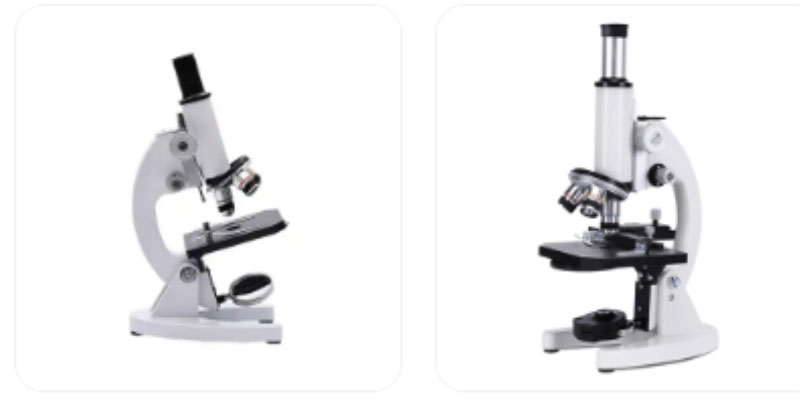
| Feature | Magnifying glass | Microscope |
| Typical magnification | About 2X to 30X | Often 40X to 1000X or higher |
| Structure | One or a few lenses | Objective lens, eyepiece, stage and illumination system |
| Best for | Small text, coins, stamps, jewelry, solder joints | Cells, bacteria, fibers and microscopic structures |
| Portability | Usually portable | Usually requires a bench or table |
| Preparation | Little or none | Often requires sample preparation |

A magnifying glass is enough for most visible surface details. If you need to see cells, bacteria or microscopic structures, you need a microscope.
How to choose the right magnifying glass
To choose the right magnifying glass, start with the job. A magnifying glass for reading should have lower power and a wide viewing area. A magnifying glass for coins, stamps or jewelry should have clearer optics and moderate to high magnification. Electronics and craft work often call for a magnifying glass with light and stand because better lighting and hands free positioning matter.
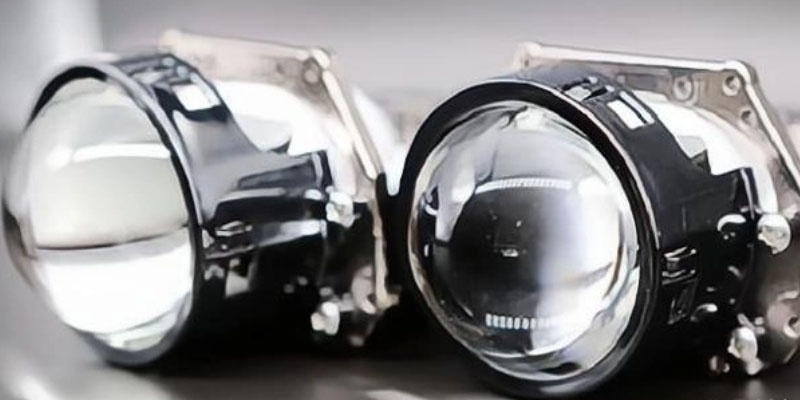
Lens material is the next thing to check. Optical glass gives clear images and good scratch resistance, so it is useful for professional inspection. Acrylic is light, affordable and less likely to break, which is why it is common in casual magnifiers and children’s hand lenses. Polycarbonate is very impact resistant and works well for outdoor, classroom and industrial safety uses. Resin lenses can offer a practical balance of clarity, weight and durability.
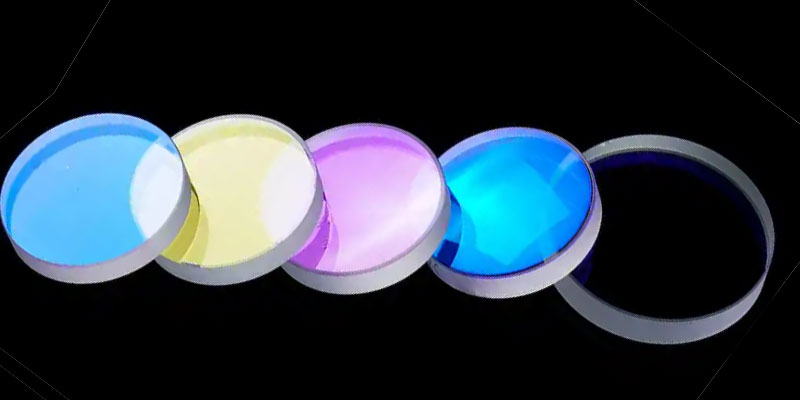
Coatings can change the experience too. Anti reflective coating reduces glare and makes the image look brighter. A hard coating helps protect plastic lenses from scratches. Anti fog coating helps when temperature changes cause condensation. UV protective coating can be useful for outdoor work.
Finally, think about comfort. A good magnifier should have the right magnification, a usable field of view, enough working distance, good lighting and low edge distortion. If you plan to use it for long sessions, comfort and clarity matter more than chasing the highest possible magnification.
Frequently asked questions
optlenses

Related Blogs