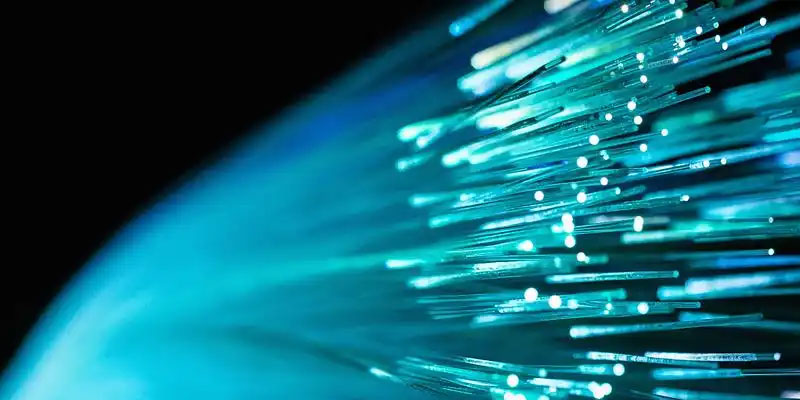
In this era of information explosion, high-speed, stable and long-distance data transmission has become paramount. How Does Fiber Optic Internet Work:Optical fibre, as the star of modern communications, has emerged as the primary vehicle for information transfer due to its unique advantages. Its core operating principle is total internal reflection, whereby light signals are confined and transmitted within specially engineered glass or plastic fibres. This enables high-speed, low-loss information transfer, fundamentally transforming our means of communication.
Structural Design: Three-Layer Architecture Forms the Foundation for Optical Transmission
Optical fibres are not mere ‘glass threads’, but comprise three meticulously engineered layers, each possessing a distinct refractive index (a measure of the difference in light propagation speed within a medium). This variation is pivotal for confining light.
The innermost layer is the core, crafted from high-purity quartz glass (or plastic). Serving as the primary conduit for light signals, it possesses the highest refractive index, denoted as n₁. The core functions like a meticulously laid motorway, providing a stable and rapid transmission path for light signals.
Enveloping the core is the cladding, composed of the same material but doped with different elements. The cladding’s primary function is to confine light through refractive index variation, possessing a lower refractive index than the core (n₂ < n₁). It acts like the guardrails flanking the motorway, ensuring light signals remain confined within the core and propagate only along its length.
The outermost layer is the cladding, composed of materials such as epoxy resin and acrylic ester. It does not participate in light transmission but primarily serves a protective function, shielding the core and cladding from damage such as abrasion and corrosion. This is akin to wrapping the motorway in a robust outer garment, ensuring its long-term stable operation.
Core Principle: Total Internal Reflection Enables Directional Light Transmission
The ability of optical fibres to transmit light signals over long distances hinges on the phenomenon of total internal reflection. This is a special optical effect occurring when light propagates from a ‘high-refractive-index medium’ (high refractive index) into a ‘low-refractive-index medium’ (low refractive index), contingent upon two prerequisites.
The first condition is that light must propagate from a medium of higher refractive index into one of lower refractive index. Within the fibre, light travels through the core (n₁). Upon encountering the interface between core and cladding, it transitions from a ‘higher refractive index (n₁)’ into a ‘lower refractive index (n₂),’ thus satisfying this requirement.
The second condition is that the angle of incidence must be greater than or equal to the critical angle. The magnitude of the critical angle is determined by the refractive indices of the core and cladding, given by the formula: sinθ_c = n₂/n₁. Since n₁ > n₂, n₂/n₁ < 1, the critical angle θ_c is an acute angle. For instance, with a core refractive index n₁ = 1.5 and cladding n₂ = 1.48, the critical angle θ_c ≈ 80°. Provided the incident angle is greater than or equal to 80°, light undergoes continuous reflection within the core, propagating along the fibre much like light reflecting off a mirror. This achieves 100% reflection, known as ‘total internal reflection’.
The remarkable property of optical fibres lies in their ability to ‘bend’. Even with slight curvature (typical of everyday cabling), the angle of incidence within the core remains greater than or equal to the critical angle, sustaining total internal reflection. Consequently, light follows the fibre’s path around bends, enabling flexible routing through walls, around beams, and similar configurations. However, if the fibre is bent excessively (such as through forced folding or sharp bending), the angle of incidence may fall below the critical angle. In such cases, light escapes into the cladding, causing ‘refractive loss’ that weakens the signal. This is why fibre optic cables must not be subjected to excessive bending.
Signal Transmission Process: The Perfect Conversion Between Electricity and Light
Optical fibres themselves only transmit ‘light signals’, whereas the networks and telephones we use daily operate on ‘electrical signals’. Therefore, signal conversion must be performed via an ‘optical terminal’ (transmitter) and an ‘optical receiver’ (receiver), following the process outlined below.
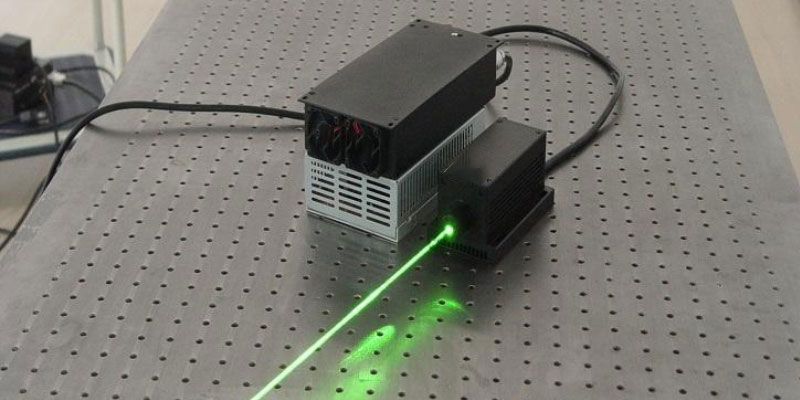
At the transmitter end, the electrical signals (high and low voltage levels representing 0 and 1) output by devices such as routers or servers are first fed into an ‘optical transmitter module’. Within the module, a laser (or LED) emits light according to the electrical signal’s ‘0/1’ control—for instance, emitting light for ‘1’ and not for “0” (or switching between different wavelengths)—thus converting the electrical signal into a ‘light pulse signal’. This light pulse signal then passes through a ‘coupler’ and is injected into the core of the optical fibre, commencing its transmission along the core.
During transmission, the light signal undergoes continuous total internal reflection within the core due to the refractive index difference between the core and cladding, propagating from one end of the fibre to the other. To minimise transmission losses (such as light scattering and absorption), the fibre core employs high-purity quartz glass (with extremely low impurity content), while a protective coating shields the core from external interference (e.g., dust, mechanical damage).
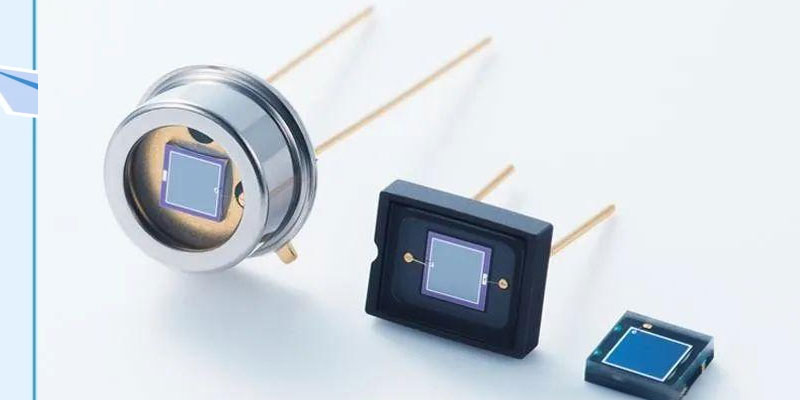
At the receiving end, the optical signal reaches the other end of the fibre and enters the ‘optical receiver module’. Within the module, a photodetector (such as a photodiode) receives the light pulses. When light is detected (corresponding to ‘1’), it generates an electric current; when no light is detected (corresponding to ‘0’), no current is generated. This converts the optical signal back into an electrical signal. The reconverted electrical signal is then transmitted to the device (such as a computer or mobile phone), where it is ultimately interpreted by us as network data, voice, or images.
Advantages of Optical Fibre: The Inevitable Choice for Modern Communications
Precisely because it operates on the principle of ‘total internal reflection’, optical fibre offers distinct advantages over traditional copper network cables (such as twisted-pair cables).
In terms of transmission speed, light propagates at approximately 300,000 kilometres per second (around 200,000 kilometres per second within glass), far exceeding the velocity of electrical signals through copper wire (approximately 50%–70% of the speed of light). This enables support for 10 Gigabit and 100 Gigabit bandwidths, meeting the demands of modern high-speed communications.
Regarding transmission distance, the optical loss in total internal reflection is extremely low (approximately 0.2 decibels per kilometre), enabling transmission over tens of kilometres without repeaters. In contrast, copper cables require signal amplification roughly every 100 metres, severely limiting their transmission range.
Optical fibres also exhibit strong resistance to interference. As light signals propagate within the fibre core, they remain unaffected by external electromagnetic disturbances (such as electrical wiring or radar signals), ensuring higher signal stability. This capability guarantees reliable data transmission even in complex environments.
Moreover, optical photonic fiber offer superior confidentiality, as optical signals cannot be easily ‘eavesdropped’ upon like electrical signals (requiring physical severing of the fibre to access the signal), thereby providing enhanced security and reliable assurance for the transmission of critical information.
The fundamental principle of optical fibre operation lies in utilising total internal reflection to confine light signals within a specially engineered core. Through an ‘electrical-to-optical-to-electrical’ signal conversion process, it achieves high-speed, long-distance, and low-interference data transmission. This is the core reason modern communications (such as 5G and internet backbone networks) rely on optical fibre. With its unique appeal, optical fibre is leading us towards a new era of faster, more convenient communications.
optlenses

Related Blogs